Gross yields of 6 to 7 percent in the main towns, rents more than doubled in three years, and prices that held their value even in a quieter year.
Northern Cyprus is a market whose numbers reward a closer look. At the end of 2024 the gross rental yield on flats in the main cities stood at 6 to 7%. Asking rents per square metre more than doubled between December 2021 and December 2024, rising by roughly 135%. Flat prices grew by 22.5% over three years and detached houses by 29.8% — and in the calmer year of 2026 they held that level. What do these figures mean for someone considering a buy-to-let purchase?
Yields in the main cities
Gross yield is a simple ratio: annual rent divided by the purchase price. At the end of 2024 it was highest in Lefkoşa (Nicosia), at around 7.0%. Girne (Kyrenia) followed with roughly 6.4% and Gazimağusa (Famagusta) with about 6.2%. In 2026 the average for flats across the whole of Northern Cyprus is approximately 5.5%.
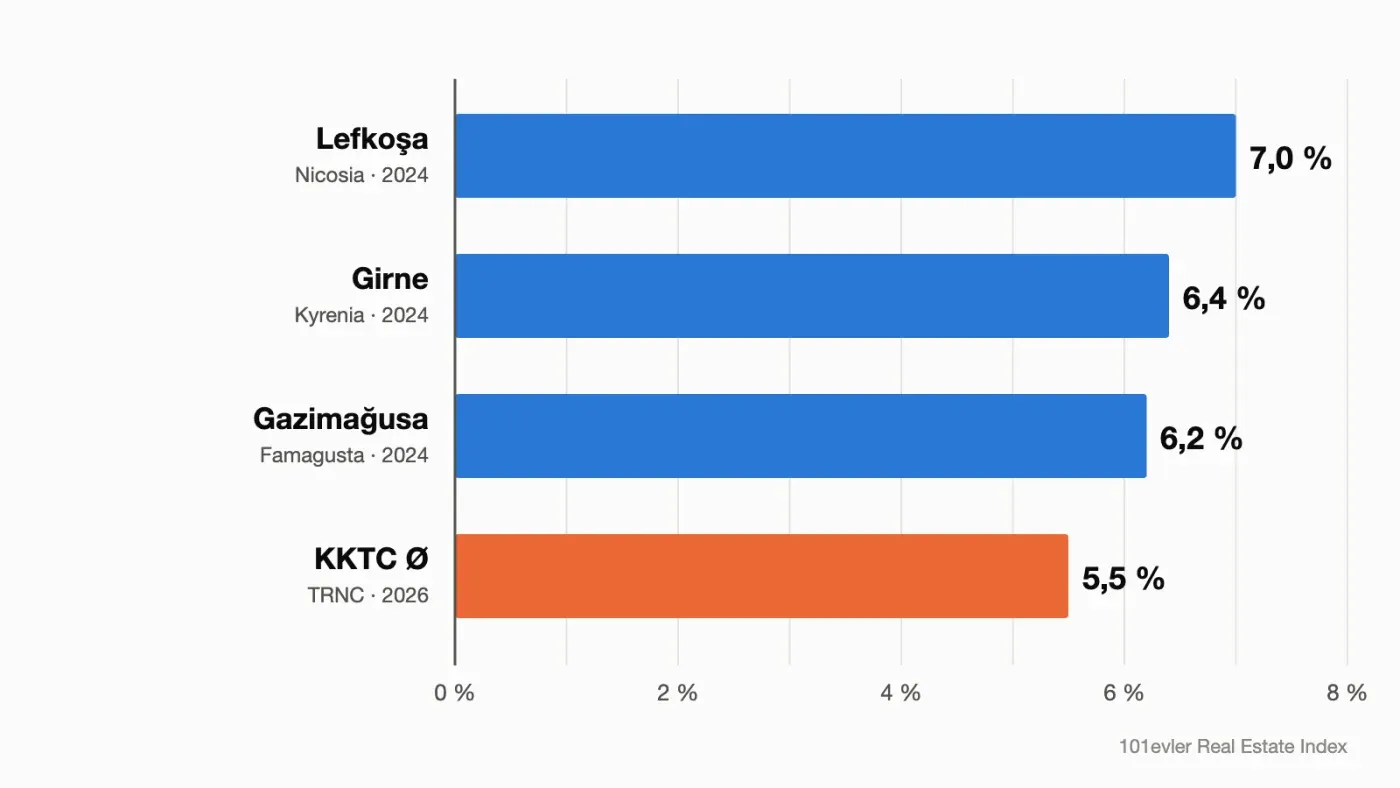
The figures come from the 101evler portal index, which is calculated from advertised prices; the city values date from the end of 2024, and the 5.5% average for the whole north is from 2026.
It is worth noting that the highest yield was not where rents are highest. What matters is the ratio of rent to purchase price — and that ratio came out best in Lefkoşa.
Rising rents and student demand
Rents have grown strongly in recent years. Between December 2021 and December 2024 the average asking rent for a flat per square metre, measured in pounds sterling, rose by roughly 135%. In Gazimağusa rents went up by 19% in 2024 alone, with demand driven by students and university enrolment.
Girne has the highest rents in the north, while Lefkoşa and Gazimağusa are considerably cheaper. Landlords increasingly ask for rent in pounds sterling and raise it every year. In 2026, after the rapid rise, rents levelled off: the average asking rent per square metre across the north is slightly below its end-2024 level.
Prices over three years
In 2026 the index for flats across the north shows growth of 22.5% over three years, and 29.8% for detached houses. Regional differences were already visible at the end of 2024: compared with the end of 2023, flats rose by 36% in Lefkoşa, albeit from a low base, by 12% in Girne and by 4.8% in Gazimağusa.
Iskele was the only area where flat prices fell that year, by 5%. Most of the three-year growth therefore came before the most recent year.
Price stability in 2026
2026 is a calmer year, with fewer deals being done. Prices, however, have not fallen: the flat index gained 0.8% over the past year and 0.1% over three months, and detached houses 1.2% over the year. Between 1 April 2025 and 1 April 2026 the overall index moved from 152.1 to 152.7. Property has held its value.
Costs are one reason. Developers report year-on-year construction cost increases of around 20%, driven by more expensive materials and a shortage of labour, and they are unwilling to sell below cost. Almost no new projects are being launched in 2026. Limited new supply thus helps existing flats hold their value, and gives buyers room to choose without the pressure of rapidly rising prices.
Long-term or short-term letting
There are two letting models. Long-term letting is the basis of the index calculations: in the main cities the gross yield stood at 6 to 7% at the end of 2024, and in university towns it is supported by student demand.
Short-term letting is seasonal. According to estate agents it can deliver as much as 9–11% “net”; overall, agencies in 2026 quote yields of 6–9%, some of 8–12%. These figures are often based on the best months of the season and on an off-plan purchase price from the construction phase, so it makes sense to recalculate them for a full year and today’s price.
Clearer rules
In May 2025 an amendment once again allowed foreigners to buy more than one property, and market activity partly recovered in the second half of 2025.
Since 11 May 2026 Decree-Law 63/2026 has been in force. It introduces a ten-year certificate of right of use, a system of licensed intermediary investors and a cap under which foreigners may buy no more than 80% of the flats in any single project. The market is thus getting clearer, more formal rules. The slower pace of deals in 2026 is most visible in Iskele and Tatlısu.
How to calculate your yield
Gross yield is a good starting point. For a realistic picture of income, deduct:
- the fee for the property manager or rental operator,
- maintenance charges for the complex,
- periods without a tenant — short-term letting is seasonal, and the student year does not last twelve months,
- furnishing the flat and wear and tear,
- insurance,
- income tax on rental income — with a registered tenancy agreement, the withholding tax known as “stopaj”.
Net yield therefore comes out lower than gross; by how much depends on the particular flat and the way it is let. When comparing offers, put like figures side by side: gross with gross, long-term rent with long-term rent, pounds with pounds. A calculation prepared this way can be compared fairly with any offer. The index average is a guide — the yield of a specific flat depends on its location, condition, purchase price and letting model.
A calculation for your property
If a particular property has caught your eye, ROCKS GLOBAL will be glad to prepare a calculation of its gross and net yield for both long-term and short-term letting, with all assumptions clearly stated. It is a basis for your decision, not investment advice.
Sources: 101evler Real Estate Index (Q4 2024 and 2026 regional report), estate agency market reports for 2026.